.png)
.png)
Why Won't My Sun Spots Fade? What a Chemical Peel Can (and Can't) Do
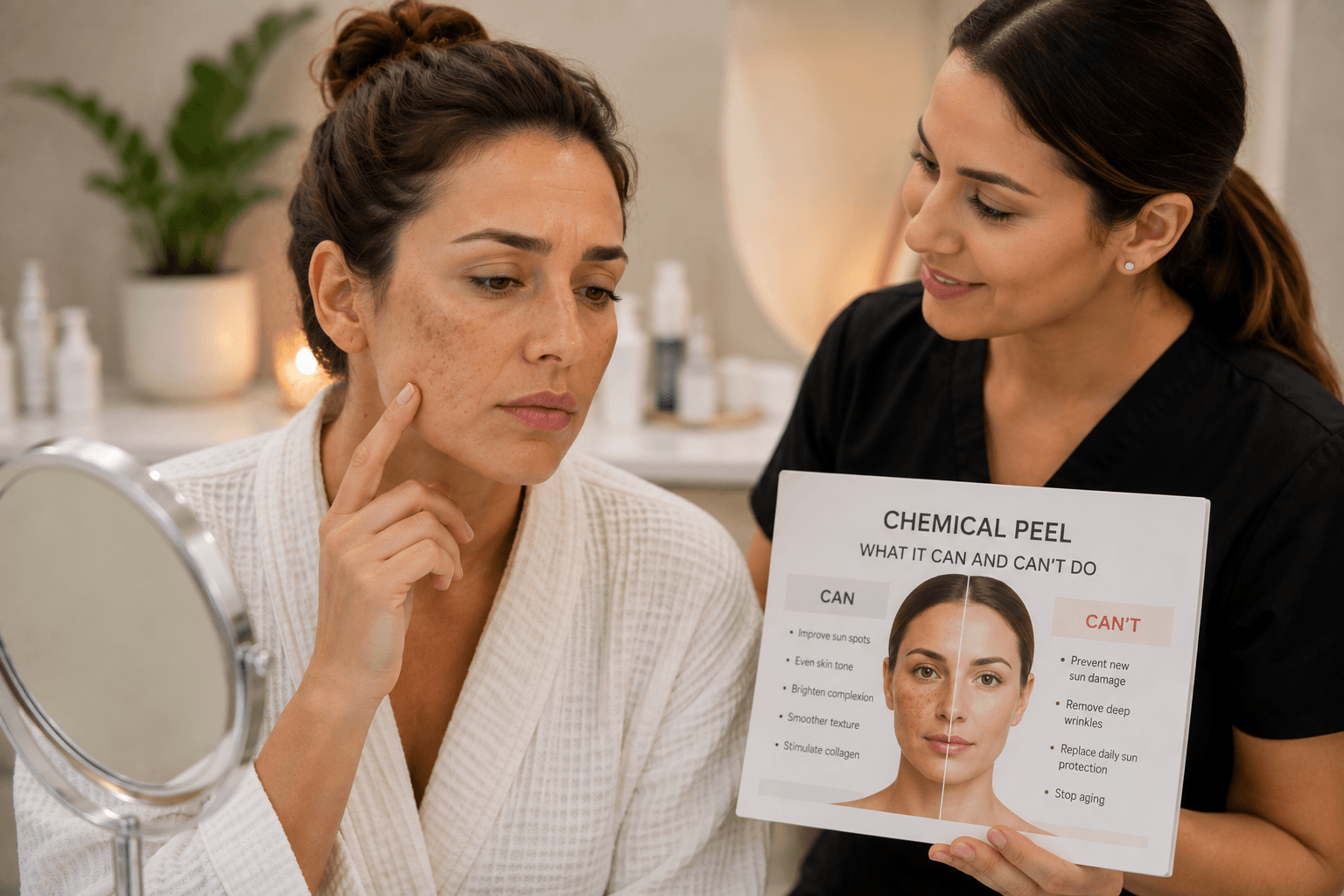
If you have lived in the East Valley for more than a summer or two, you already know what the Arizona sun can do to skin. Dark patches show up on the cheeks and forehead. A sunburn from years ago leaves behind a faint but stubborn shadow. Skin tone starts to look uneven, blotchy, or just tired, even when you are religious about sunscreen. The frustrating part is that these marks rarely fade on their own, no matter how many brightening serums you try.
This is one of the most common skin concerns we hear about at Skin By You, and it makes sense. Queen Creek sits in one of the sunniest parts of the country, and sun exposure is the single biggest driver of visible pigment changes, rough texture, and premature fine lines. The good news is that a chemical peel is one of the most effective, well studied ways to address sun damage at its source instead of just covering it up. This article walks through why sun spots form, why they linger, and how a peel actually works to fade them, so you can decide whether it is the right next step for your skin.
Updated August 2026 with current information on chemical peel treatments in Queen Creek, Arizona.
What Causes Dark Spots and Uneven Skin Tone in the First Place?
Sun spots, also called solar lentigines or age spots, form when ultraviolet light triggers melanocytes, the pigment producing cells in your skin, to go into overdrive in one particular area. Instead of spreading pigment evenly, those cells cluster together and create a visible patch that is darker than the surrounding skin.
According to the American Academy of Dermatology, cumulative sun exposure over years is the leading cause of these spots, which is why they tend to show up on the face, chest, shoulders, and hands first. Arizona's high UV index means that even a few unprotected afternoons a summer can add up faster here than in cloudier climates.
Why Do Some People Get Sun Spots and Others Don't?
Genetics, skin tone, and how much unprotected sun exposure someone has had over their lifetime all play a role. Fair skin tends to show pigment changes earlier, but no skin type is immune. Hormonal shifts, certain medications, and even repeated heat exposure from things like hot yoga or sauna use can also make skin more reactive to the sun.
Is It Just Sun Spots, or Could It Be Melasma?
Not all uneven pigment is the same. Melasma tends to appear in larger, symmetrical patches, often across the cheeks, forehead, or upper lip, and is closely tied to hormones as well as sun exposure. Sun spots, on the other hand, are usually smaller, more defined, and appear anywhere skin has taken repeated UV hits. A skincare professional can help you tell the difference, which matters because treatment approaches can vary.
Why Won't Dark Spots Just Fade on Their Own?
This is the question we hear most. Once melanin has clustered into a visible spot, it sits deeper in the skin than the pigment in the surrounding area. Your skin does naturally turn over and shed cells, but that process slows down with age, and it is simply not efficient enough to clear out concentrated pigment on its own. Over the counter brightening products can help fade very superficial discoloration over months, but stubborn spots usually need something that works at a deeper level.
Does Sunscreen Alone Stop the Problem?
Sunscreen is essential, and skipping it will make any pigment concern worse, but sunscreen prevents new damage rather than reversing what has already happened. Think of it as stopping the bleeding rather than healing the wound. If you already have visible spots, sunscreen keeps them from getting darker, but it will not lift the pigment that is already there.
Can Uneven Skin Tone Be a Sign of Something Else?
Occasionally, changes in a mole or spot, especially ones that grow, bleed, change shape, or have irregular borders, can be a sign of something that needs medical attention rather than a cosmetic one. If you notice a spot behaving differently than the others, it is worth having a dermatologist take a look before pursuing any cosmetic treatment.
How Does a Chemical Peel Actually Fade Sun Damage?
A chemical peel uses a carefully formulated acid solution to remove the outermost, damaged layers of skin. As those layers slough off, they take built up pigment, rough texture, and dull surface cells with them. This encourages fresh, more evenly toned skin to surface underneath, and it stimulates the skin to produce new collagen along the way.
At Skin By You, our Factor Five No-Downtime Peel is designed specifically for clients who want visible improvement in tone and texture without needing to disappear from daily life for a week of peeling and redness. It is a favorite among Queen Creek clients who want brighter, more even skin before an event, a trip, or simply because they are tired of makeup that cannot quite cover the discoloration.
For clients dealing with breakout related pigment as well, our Acne Bootcamp Peel targets both active blemishes and the dark marks they tend to leave behind.
What Does the Treatment Feel Like?
Most clients describe a warming or tingling sensation while the solution is on the skin, followed by a few days of light flaking or brightness rather than heavy peeling, depending on the depth of the treatment. Because everyone's skin responds a little differently, we always start with a consultation to talk through your goals, your skin history, and how many sessions are realistic for your particular concern.
How Many Sessions Will I Need?
For sun spots and general tone correction, most people see noticeable improvement after a series of treatments spaced a few weeks apart, since skin needs time to fully turn over between sessions. Deeper or longstanding spots typically respond better to a series than to a single treatment, which is why we build a plan around your specific skin rather than offering a one size fits all schedule.
Who Should Consider a Chemical Peel for Sun Damage?
A peel tends to be a great fit for anyone with sun spots, dullness, rough texture, or uneven tone who wants a professional, results driven option rather than relying on products alone. As with any skin treatment, certain conditions, medications, or very recent sun exposure can change what is appropriate, which is why a proper consultation matters more than guessing based on what worked for a friend.
Protecting Your Results Once Your Tone Evens Out
Getting your skin tone back on track is only half the equation. Queen Creek's climate means the sun is a year round consideration, not just a summer one. Daily broad spectrum sunscreen, a hat during peak hours, and avoiding unnecessary midday exposure will help protect your investment. Many clients also pair their peel series with a HydraFacial or one of our hydrating facial experiences to keep skin balanced and glowing between peel sessions.
Ready to See What Your Skin Looks Like Underneath the Sun Damage
Sun spots and uneven tone are common, but they are not something you have to live with indefinitely. If you are curious whether a chemical peel is the right fit for your skin, our team at Skin By You can walk you through your options and build a plan around your goals. Visit our services page to see everything we offer, browse real client results on our before and after page, or head to our contact page to book a consultation in Queen Creek, Arizona.
Frequently Asked Questions
Will a chemical peel completely remove sun spots? Many clients see significant fading, and some spots clear almost entirely, but results depend on how deep the pigment sits and how many sessions you complete. A series typically produces better results than a single treatment.
Is a chemical peel safe for sensitive or fair skin? Yes, when the right strength and formulation is chosen for your skin type. This is why a consultation before treatment matters, since not every peel is appropriate for every skin type or concern.
How long does it take to see results after a chemical peel? Some brightness is visible within days, but full results from pigment correction usually build over several weeks as skin continues to turn over.
Can I get a chemical peel if I have melasma instead of sun spots? Melasma can respond to certain peels, but it also requires a more cautious, tailored approach since it is more likely to flare with irritation. Our team will assess your skin before recommending a plan.
Do I need to avoid the sun after getting a chemical peel? Yes. Freshly treated skin is more sensitive to UV exposure, so daily sunscreen and limiting direct sun for at least a few days after treatment is important for both safety and results.
The Real Glow Up Nobody Warns You About
Fading sun damage is not about chasing a filter worthy complexion. It is about giving your skin room to recover from years of Arizona sunshine and finally look like it is keeping up with how you actually take care of it. If stubborn spots and uneven tone have been bothering you, a conversation with our team at Skin By You is a good place to start.

.png)


.png)